CVSA Brake Safety Week
July 15, 2025 | Safety | By Tri-County International Trucks
The enforcement campaign is part of Brake Safety Awareness Month, which takes place throughout August.
During CVSA’s annual enforcement event, roadside inspectors will:
-
Conduct North American Standard Inspections with a focus on brake systems and components.
-
Pay special attention this year to brake drums and rotors.
The CVSA will issue a report on its findings later this year.
Brake Safety Week also serves as an important opportunity for motor carriers to educate their drivers and maintenance service providers on the critical importance of brake safety.
Proper Steps to Take in Preparing for Winter Driving Conditions
December 17, 2024 | Safety | By Tri-County International Trucks
Step 1: Prepare Your Truck for Winter Driving
Tires are the most important factor in maintaining control of your vehicle in snowy and icy conditions. Traction tires on the drive axle(s) with adequate tread depth provide the best control. The tread depth and condition of the steer axle tires are also crucial for maintaining control of steering. If you are operating in areas with chain laws, ensure your chains are in good condition and ready to be installed if necessary. Additionally, make sure that all mirrors and glass on the truck are clean for optimal visibility.
Step 2: Turn Your Lights On
Turn on your lights to improve your visibility to other motorists.
Step 3: Avoid Using Cruise Control
Do not use cruise control on snowy or icy roads.
Step 4: Be Cautious on Bridges, Overpasses, and Infrequently Traveled Roads
Exercise extra caution on bridges, overpasses, and infrequently traveled roads, as these areas freeze first. Even if the temperature is above freezing, you may encounter ice on shaded areas or exposed roadways, such as bridges.
Step 5: Don’t “Pump” the Brakes
If your truck is equipped with ABS brakes, do not "pump" the brakes. Let the system function as designed.
Step 6: Drive Slowly
Driving too quickly is a leading cause of winter accidents. Just because you are driving a large truck with a heavy load doesn't make you invincible. Be sure to drive slowly and cautiously on snow- and ice-covered roads.
Step 7: Stay Alert
Maneuvering is more challenging in snowy conditions. Anticipate your next move, giving yourself plenty of room for turns and stops.
Step 8: Don’t Tailgate
Tailgating is dangerous under normal conditions, but it is especially hazardous in winter weather. Stopping takes longer on snow and ice compared to dry pavement. Leave plenty of space between your vehicle and the one in front of you. A good rule of thumb is to maintain four vehicle lengths for every 10 mph you are driving.
Step 9: Brake Before Making Turns
It is difficult to steer while applying the brakes in snowy conditions. Smoothly apply the brakes to reduce speed before entering a turn. Once you have rounded the corner, you can accelerate again.
Step 10: Drive Smoothly
Snowy and icy roads are much less forgiving than dry pavement. Avoid abrupt turns or stops, as they can cause your vehicle to lose control and skid.
Step 11: Be Familiar with Your Vehicle
It’s essential to understand your vehicle's handling characteristics, especially when driving on snow or ice. Be aware of your truck’s load and weight. As the load decreases, the vehicle’s handling on snow and ice will change.
Step 12: Learn How to Control Skids
While it’s best to practice skid control in a driving school or on a closed course, it’s also helpful to know how to react if you experience a skid under real-world conditions. When skidding, counteract your natural instincts by turning into the skid and accelerating gently. Taking your foot off the brakes and gently accelerating during a skid helps transfer weight from the front to the rear, often allowing you to regain control.
For additional information on weather and road conditions, visit the FHWA's website at http://www.fhwa.dot.gov/trafficinfo/index.htm, which provides links to weather and road condition resources, travel websites, and 511 services.
Preparing for the Cold Weather
October 3, 2024 | Safety | By Tri-County International Trucks
Fuel Additive Use during Cold Weather Conditions
To prevent fuel jelling, additives should be added whenever the ambient temperature falls below 32°F. Power Service and Penray are two popular manufacturers of fuel additives, each offering a range of products available through Navistar and Idealease locations.
Power Service:
- The "Red Bottle," known as Power Service 911, should be used only when the fuel in a unit has already jelled.
- 911 is NOT to be used as a fuel additive that you would regularly put in the fuel tank to keep the fuel from jelling.
- Power Service Diesel Fuel Supplement + Cetane "White Bottle" is to be added to the fuel at each fill when the ambient temperature is < 30 degrees F.
- This is the additive you should use on a regular basis during the winter months.
Penray:
Winter Than Emergency Diesel Fuel Supplement
- Dissolves already gelled fuel fast and reduces clogging of fuel filters. Prevents ice crystal build-up in fuel lines and filters by disbursing moisture.
- Eliminates hard starting, pounding, excessive smoking and helps improve combustion. 100% compatible with low sulfur fuel and fuel blends.
Winter Pow-R Plus Diesel Fuel Supplement
- ULSD compliant
- Prevents diesel fuel gelling
- Prevents ice crystal formation
- Reduces cold filter plug point by up to 30 degrees
- Enhances cetane levels
- Improves fuel economy
- Utilizes HAFI® technology
- Aids cold weather starting
- Stabilizes fuel and prevents corrosion
- Helps reduce emissions
- Improves lubricity
How to Make a Cold Weather Survival Kit
Everyone should carry a Winter Survival Kit in their truck. In an emergency, it could save your life. Here is what you need:
- A shovel
- Windshield scraper and small broom
- Flashlight with extra batteries
- Battery powered radio
- Water
- Snack food including energy bars, raisins, and mini candy bars
- Cold Weather Survival Kit
- Matches and small candles
- Disposable Hand/Foot warmers
- Extra hats, socks and mittens
- First aid kit with pocket knife
- Necessary medications
- Blankets or sleeping bag
- Tow chain or rope
- Road salt, sand, or cat litter for traction
- Booster cables
- Fluorescent distress flag and whistle to attract attention
- Cell phone adapter to plug into lighter and or extra battery supply
CVSA's Brake Safety Week Scheduled for Aug. 25-31
June 11, 2024 | Safety | By Tri-County International Trucks
Brake Safety Week is a commercial motor vehicle and driver inspection and regulatory compliance enforcement initiative, a brake-safety awareness and outreach opportunity, and a brake-related inspection and violation data-collection project.
Inspection and Enforcement
CVSA-certified inspectors will conduct routine commercial motor vehicle inspections throughout the week, with a focus on brake systems and components. Any commercial motor vehicles found to have brake-related out-of-service violations will be removed from roadways until those violations are corrected.
For this year’s Brake Safety Week, inspectors will focus on the condition of brake linings and pads. Brake lining and pad issues may result in vehicle violations and could affect a motor carrier’s safety rating.
In addition, some jurisdictions have performance-based brake testers (PBBT) and will be using them during Brake Safety Week. A PBBT is a machine that assesses the braking performance of a vehicle.
These truck parts specials won't last long!
June 20, 2023 | Maintenance | By Tri-County International Trucks
Fleetrite Gold Batteries
Summer heat is tougher on batteries than winter's chill, with hot temps speeding up the onset of battery failure. As a result, many motorists wind up stuck along the roadside in the summer. AAA reports that it responded to 2.2 million battery-related service calls in the summer of 2020, up from 1.8 million in 2018.
Save yourself from being stranded by buying a new set of Fleetrite Gold batteries today! They feature anchor bonding for vibration resistance and stamped grid technology for a longer life. All Fleetrite® batteries are International and IC Bus aftermarket quality approved. The FLTBTG31950 Group 31 950CCA battery is $108.99 with a $27 core charge at all our locations!
Happy 4th of July!
Tri-County will be closed on Tuesday, July 4. We wish everyone a happy and safe holiday.
In-Store Specials
Check out our Parts Specials that are available now through June 30.
Subscribe to the Tri-County Minute
Get the most up-to-date information by subscribing to our e-mail newsletter for specials, news, trucks and more.
RepairLinkShop has the truck parts you need
May 23, 2023 | Maintenance | By Tri-County International Trucks
RepairLinkShop
Free to you, RepairLink delivers a complete electronic all-makes parts search. Not only do you have access to our pricing and inventory availability, you can also view illustrations and technical diagrams, making this solution a valuable resource for you. Access our online marketplace, browse our global parts inventory and order parts today.
S13 Integrated Powertrain
The S13 Integrated Powertrain, developed in collaboration with the TRATON Group, demonstrates advancements in robustness, reliability and performance. This latest announcement showcases a continued commitment to customers by setting the foundation for the next generation of vehicles, technologies and comprehensive ownership solutions.
Holiday Hours

Tri-County International Trucks locations will be closed from May 27-29 for Memorial Day Weekend. We wish everyone a happy and safe holiday!
Join Our E-Mail List
Subscribe to our e-mail list, and make sure you never miss the latest updates from Tri-County International Trucks!
Seats Specials at Tri-County International Trucks
May 9, 2023 | Maintenance | By Tri-County International Trucks
Shop Our Large Inventory of Truck Parts
April 25, 2023 | Maintenance | By Tri-County International Trucks
Tri-County stocks a large inventory of International Truck parts and accessories, from engine oil to entire engines, including rebuilt and exchange units. If a part isn’t stocked at a Tri-County location, we leverage our network to deliver hard-to-find parts to you quickly. Click here for more information.
Cold Weather Tips
February 8, 2022 | Maintenance | By Tri-County International Trucks
- Diesel supplement should be added to the ultra-low sulfur diesel fuel when temperatures drop below 32 degrees.
- If your truck is equipped with an engine block heater it should be plugged in when the temperature is below 32 degrees. Trucks that are not utilized should be started and let run every day to bring the unit up to normal operating temperature.
- The initial start-up procedure should be as follows: Complete pre-trip of the unit, unplug block heater, turn the ignition switch on, and wait for glow plug lights to go out, start the engine, leave engine run until engine operating temperatures increase.
- For trucks equipped with air brakes, drivers should purge air tanks daily. If the unit is equipped with an air drier, bringing the PSI to 120 will automatically purge the system.
- If you are driving in snow, ice, slush, rain, etc., before parking the unit for the day you should lightly apply the brakes while the unit is moving to dry the brake shoes, drums, rotors, and pads so the brakes do not freeze while parked.
- Make sure the windshield washer solvent is full and all windows are clean.
- Remove any ice-snow build-up from steps and grab handles to prevent a slip or fall.
When parking the unit, if heavy snow is in the forecast, make sure the unit is not left parked in an outside dock or near a building overhang. Snow can drift off the building causing excessive accumulation on the top.
Fuel Additive Use during Cold Weather Conditions
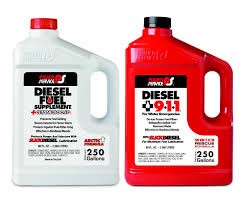
As colder weather approaches you to need to use fuel additives to prevent fuel jelling. Fuel additives should be added anytime the ambient temperature is below 32 degrees F. Power Service and Penray are popular manufactures of fuel additives and both companies have two different products available through Navistar and Idealease locations.
Power Service:
-The "Red Bottle" is Power Service 911 and is to be used ONLY when the fuel in a unit has been jelled
-911 is NOT to be used as a fuel additive that you would regularly put in the fuel tank to keep the fuel from jelling
-Power Service Diesel Fuel Supplement + Cetane "White Bottle" is to be added to the fuel at each fill when the ambient temperature is < 30 degrees F
-This is the additive you should use on a regular basis during the winter months
Penray:
Winter Thaw Emergency Diesel Fuel Supplement
-Dissolves already gelled fuel fast and reduces clogging of fuel filters
-Prevents ice crystal build-up in fuel lines and filters by disbursing moisture
-Eliminates hard starting, pounding, excessive smoking, and helps improve combustion.
-100% compatible with low sulfur fuel and fuel blends.
Winter Thaw Emergency is ONLY TO BE USED WHEN THE FUEL IS ALREADY JELLED!
Winter Pow-R Plus Diesel Fuel Supplement
-ULSD compliant
-Prevents gelling of diesel fuel and ice crystal formation
-Reduces cold filter plug point b as much as 30ºF
-Helps enhance cetane and improve fuel economy.
-Utilizes HAFI® technology.
-Improves cold-weather starting.
-Stabilizes and prevents corrosion.
-Helps reduce emissions and improves lubricity
How Drivers Can Impact Tire Cost and Tire Safety
October 20, 2020 | Maintenance | By Tri-County International Trucks
Next to fuel, tires have been and will continue to be the #1 maintenance issue facing fleets today. Drivers can have an enormous impact on your tire expenses and their safety during a pre-trip inspection and while they are on the road. During the pre and post trip inspection, it is important for drivers to visually inspect tires for any sign of irregular wear, cuts, snags, and punctures; and report that information to the maintenance department either directly or through a DVIR. But what about checking the tire air pressures during the walk-around inspection? It does take time to check the air pressure on 6 to18 tires and how does the driver know that the pressure gauge he is using is even accurate? After checking the air pressure, it is also possible that a valve core can stick causing the tire to lose air. The driver, of course, would need to know what the recommended air pressure is for steer, drive, and trailer tires. Many fleets have different specs for air pressure depending on wheel position. Even if the driver completes these checks, what if he (or she) finds that the inside dual drive tires are all 10 PSI too low. If the driver is on the road, will they take the vehicle to a truck stop to get air? The driver does not own the vehicle so why should he care if the tire is 10 PSI underinflated. This is exactly why it is so important to educate your drivers upon hire and during employment about tire maintenance and safety. Most drivers have no idea that the tires on a tractor/trailer unit may have cost over $7,500. During new driver orientation and safety meetings, drivers need to hear about tires and how they can influence:
- Safety of operating the CMV
- Tire removal mileage
- Fuel economy
- Retread ability
- Tire related roadside service calls
Drivers must fully understand that their jobs depend on helping their employer do everything in their power to get the most out of their $6000 tire investment. If the driver understands that there is a direct correlation between running tires underinflated and fuel economy, he/she could save the company close to $1000 per year in fuel alone. There’s more that the driver can do: If the driver, in a pre/post trip inspection can identify a possible vehicle alignment condition based on steer tire irregular wear, that tractor could be fixed and the tires saved from early removal. And his driving habits matter as well - if the driver does not accelerate aggressively and makes smooth turns, tires will last a lot longer as the tread rubber will not be scrubbed off as quickly. Striking curbs is also a leading cause of ending a tires life prematurely. Many fleets today recognize the role the driver can play in maximizing their tire budget. Most have some sort of incentive program for those drivers who can generate the most miles on their tires and can consistently get the best fuel economy by keeping their tires properly inflated ALL the time. Having a program to educate drivers on these issues can save your company in a very short time.
Measuring Tire Tread Depth

Tread depths need to be checked and recorded because DOT has a legal limit -4/32” for steer tires and 2/32” of rubber for drive and trailer tires. That means that if any spot in the major grooves of a steertire are found to be 4/32” or less, that tire must be removed from service. However, it can either be retreaded or moved to the trailer and run down to 2/32" minimum before entering the retreading process. Drive tires would be required to be removed from service or retreaded when any major groove reaches 2/32” of rubber to be safe. Most fleets have found over the years that running the tire down to 2/32”.
The last tip about measuring tread depth: never measure in the decoupling groove which is found in many steer tire designs to reduce irregular wear. This outside decoupling groove is sometimes known as a PDG groove (Pressure Distribution Groove) and they may be very deep or may be very shallow–but it is not the same depth as the major tire grooves.
November 1st-8th is Drowsy Driving Prevention Week
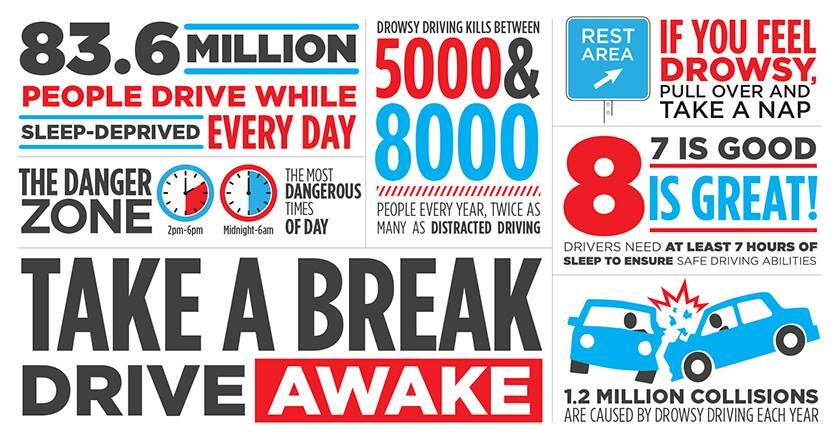
The National Sleep Foundation has launched Drowsy Driving Prevention week as an educational campaign designed to save lives by increasing awareness of the dangers of driving while sleepy. The National Highway Traffic Safety Administration estimates that drowsy driving causes at least 100,000 police-reported crashes and kills more than 1,550 Americans each year.
It is curious that all states have laws in place to enforce drunken driving but few have laws to cite a driver who has fallen asleep causing an accident. Only the state of New Jersey explicitly defines drowsy driving as recklessness under a vehicular homicide statute. Known as "Maggie's Law," New Jersey's drowsy driving law has served to raise awareness of the consequences of fatigue behind the wheel and has spurred significant action in other states. There are now at least 8 states with 12 pending bills that address fatigued driving in various ways.
For more information on Drowsy Driving Prevention Week, visit www.drowsydriving.org.
CSA Violation List Updated in Time for September Snapshot
The list of severity-weighted violations appearing in the Safety Measurement System (SMS) Methodology was updated in late September to better align with the roadside inspection program. The violations are a key part of the algorithms used to score motor carriers and drivers under the Compliance, Safety, Accountability (CSA) enforcement program.
The Federal Motor Carrier Safety Administration's (FMCSA) updated methodology:
Added 63 violations,
Removed 4 violations, and
Updated the descriptions of 34 violations.
These changes took effect in the SMS with the September 25, 2020 snapshot.
What changed?
Many of the revisions are best described as "housekeeping." High-level citations were replaced with more descriptive violations. For instance, "Operating a CMV without a CDL" now has multiple violations beneath it identifying specific violations for failing to have the proper endorsement for the vehicle being operated.
One of the more notable additions relates to information provided to roadside inspectors from the CDL Drug and Alcohol Clearinghouse. Inspectors can see whether a CDL driver is prohibited from performing a safety-sensitive function, and consequently, place the driver out of service. The roadside inspection report would cite " 390.3E -Prohibited from performing safety sensitive functions per 382.501(a) in the Drug and Alcohol Clearinghouse." The violation is now scored under CSA, using a severity value of 10, the highest possible.